
Added functionality for Merger LRF models: download the firmware update now
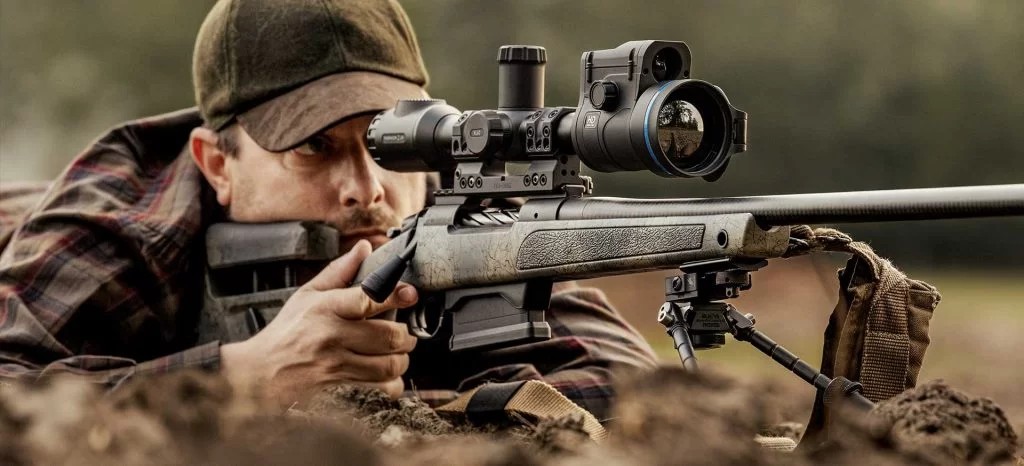
At IWA OutdoorClassics, Pulsar expert Stefan Orman spoke about a critical challenge for modern hunters: how new technologies in hunting optics influence the decisions we make in the field.
His talk focused on the transition from vision to decision — how the information we see through electro-optical devices affects shot placement, animal identification, and ultimately ethical hunting.
While technologies such as thermal imaging, digital night vision, and AI-assisted tools offer powerful capabilities, they also introduce new limitations that hunters must understand.
Quick answer
For hunters using thermal or digital optics, the most important factor is low latency. According to Pulsar expert Stefan Orman, latency directly affects shot placement because digital devices process images before displaying them.
If the delay between reality and the screen image is too high, the hunter may aim at a position where the animal no longer is.
Beyond latency, several other factors determine whether a hunting optic supports ethical and accurate decisions:
- Reliable identification over detection range – detecting an animal does not mean you can identify its species, gender, or whether young animals are present.
- Sufficient field of view – a wider field of view helps hunters understand what is happening around the target and ensures a safe backstop.
- Careful use of AI and ballistic tools – automated calculations or AI-enhanced images should never replace verified data or real-world observation.
- Proper device configuration – correct gain, brightness, contrast, and palette settings help produce a clearer image and reduce decision errors.
In short, advanced technology should help hunters move from vision to decision, but only if the information shown in the optic is accurate, timely, and trustworthy.
What happens when our natural vision no longer works
When we hunt in darkness, our built-in sensors — our eyes — no longer function the way they do during daylight.
To compensate for this limitation, hunters rely on optics.
With traditional optical scopes, the image is purely analog. The information we see travels through the scope at the speed of light, with no delay.
However, this is not the case with:
- thermal optics,
- digital night vision,
- other electro-optical devices.
These systems capture the image with a sensor, process it digitally, and then display it on a screen. Because of this digital processing, there is always a possibility that the image we see is slightly delayed.
This delay is known as latency, and it can directly affect shot placement if the hunter is not aware of it.
Why is latency the most important factor in digital hunting optics
When Stefan Orman evaluates devices for his own hunting style, one factor stands above everything else: latency.
Latency is the delay between what is happening in reality and what appears on the screen of the optic.
Even if a device operates at 50Hz or 60Hz refresh rates, additional image processing can introduce delay. Manufacturers often try to improve image quality by lowering noise and increasing contrast. However, these processes require computation, which can create latency.
Some devices on the market can introduce delays of up to half a second.
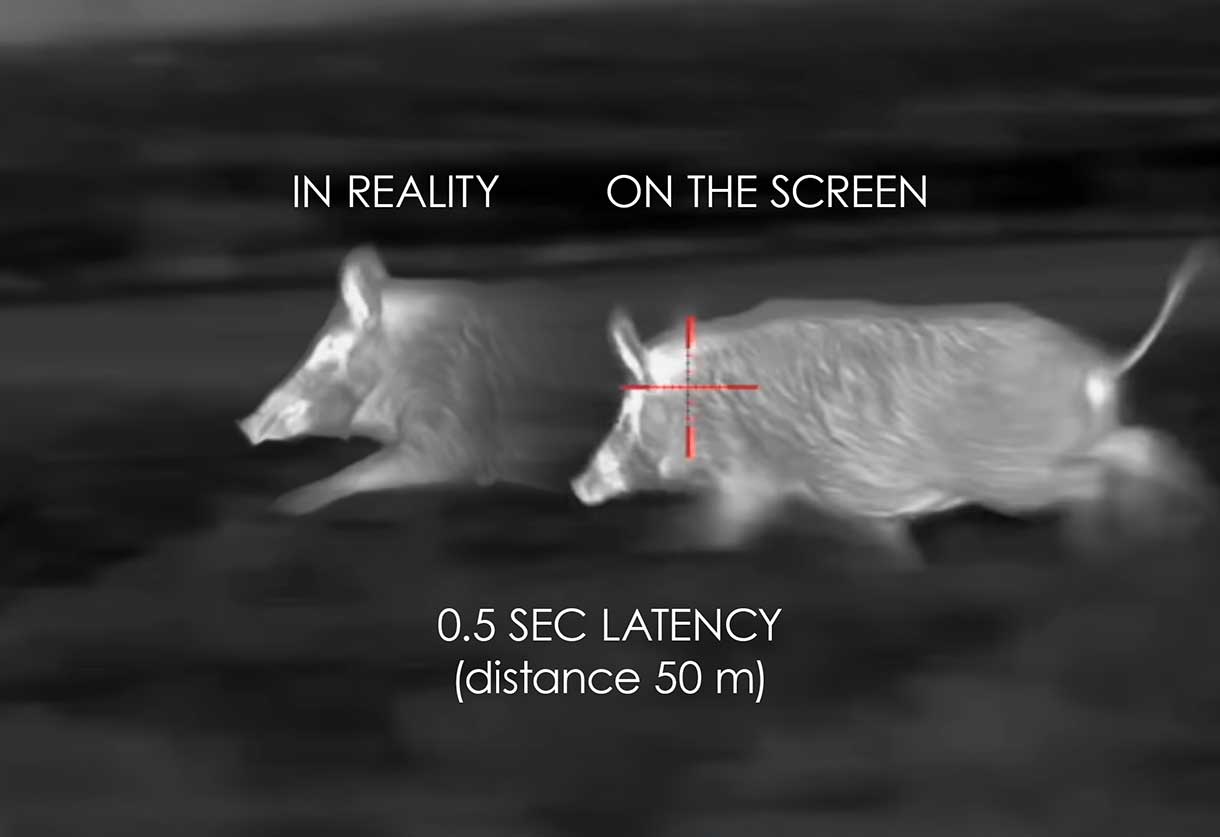
In a hunting scenario, this delay can make proper shot placement extremely difficult.
A hunter might believe they have the correct lead on an animal based on what they see on the screen. In reality, the animal has already moved. The result can be a poor shot — hitting the animal in the gut or the rear.
This is exactly what hunters want to avoid. The goal is always a clean, ethical kill.
Can image sharpness create identification problems?
Another issue appears when manufacturers try to produce extremely sharp images.
To achieve this, lenses may use lower F-stop values, which results in a shallow depth of field. While one object appears very sharp, objects in the foreground or background may become blurred.
This can create problems when multiple animals are present.
For example, when hunting certain animals, a group may contain both a mother and a young. If the depth of field is too shallow, only one animal may appear clearly while others remain blurred.
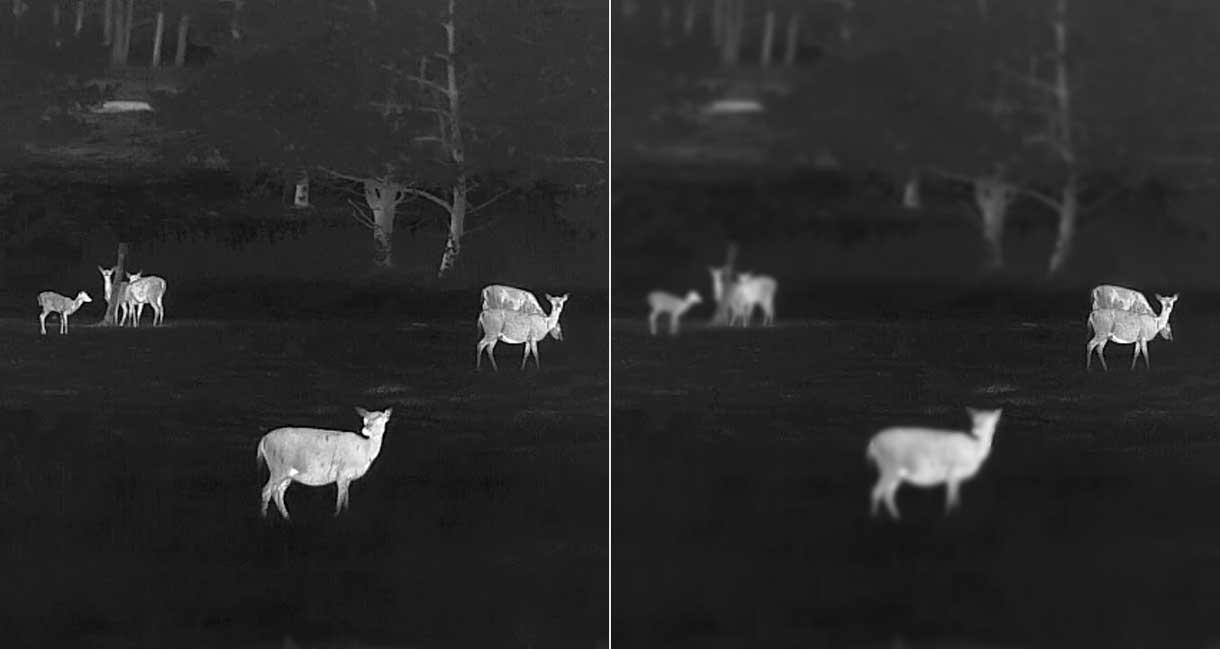
If the hunter cannot clearly identify which animal is the young and which is the mother, the wrong animal might be shot.
This can lead to a situation where the young is left behind and starves — an outcome that is clearly unethical.
What risks does AI introduce in ballistic calculators
Artificial intelligence is increasingly appearing in shooting technology, including ballistic calculators.
Most experienced shooters rely on DOPE data (Data On Previous Engagement). This data is collected through real testing and includes information such as:
- projectile dimensions,
- bullet weight,
- twist rate,
- environmental conditions.
This confirmed data becomes the baseline for accurate shooting.
However, some ballistic calculators now include manufacturer data libraries. The problem is that this information may only be accurate for the specific rifle used during testing.
It is not guaranteed to be accurate for the hunter’s own rifle.
Because of this, relying on such shortcuts can become problematic. Ballistic calculators are excellent tools for shooters who understand what they are doing, but they should never replace real testing and verified data.
How AI-generated image information can become dangerous
Another concern appears when AI is used to enhance images from sensors.
When a sensor reaches its maximum range, it may no longer have enough resolution to capture meaningful detail. Some AI systems attempt to fill in missing information by predicting what should be there.
This is where a serious problem can arise.
For example, when hunting wild boar in Sweden, it is illegal to shoot a sow with piglets.
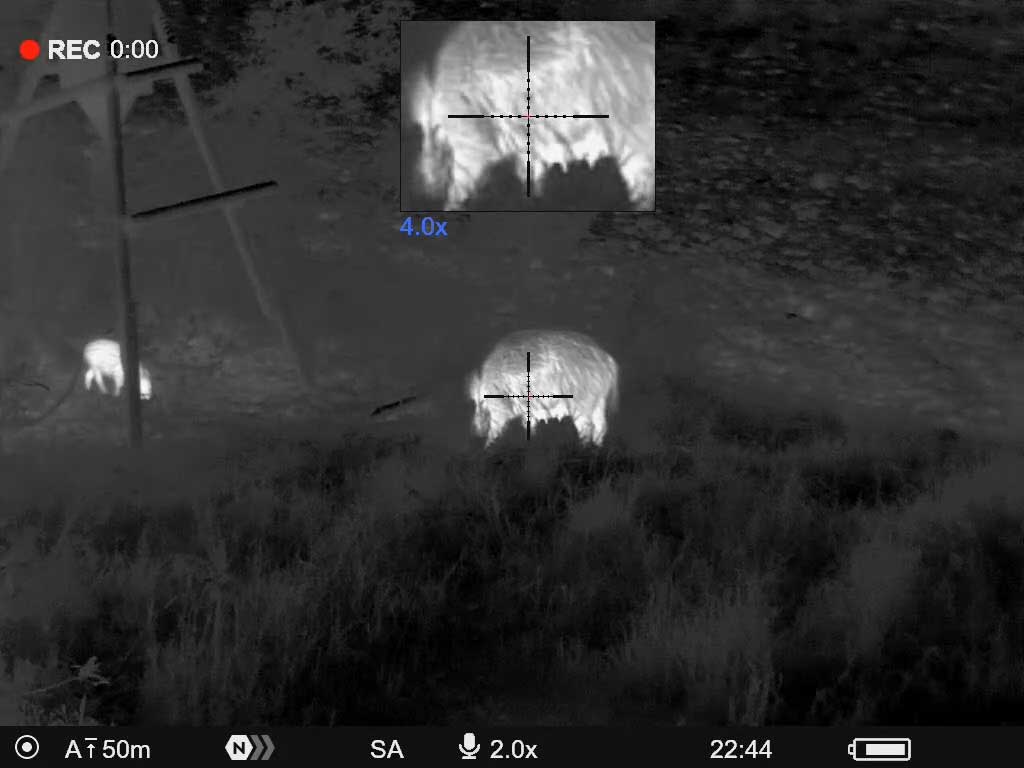
Imagine a situation where a sow has only one piglet remaining. At a certain distance, the sensor may no longer clearly distinguish the animals. If AI incorrectly identifies the animal as a male boar, the hunter could end up shooting the wrong animal.
The hunter is always responsible for every shot they take. But if the information provided by the optic is inaccurate, the risk of unethical outcomes increases.
AI could still be helpful in other areas, such as automatically optimizing:
- gain levels,
- amplification,
- brightness and contrast.
These adjustments could help novice users create a better image. However, such systems must be thoroughly tested to ensure they do not introduce false information.
Performance factors hunters should prioritize in modern optics
Instead of focusing on automated features, several core performance factors remain essential.
How low should latency be?
For Stefan Orman, the most important requirement is the lowest latency possible.
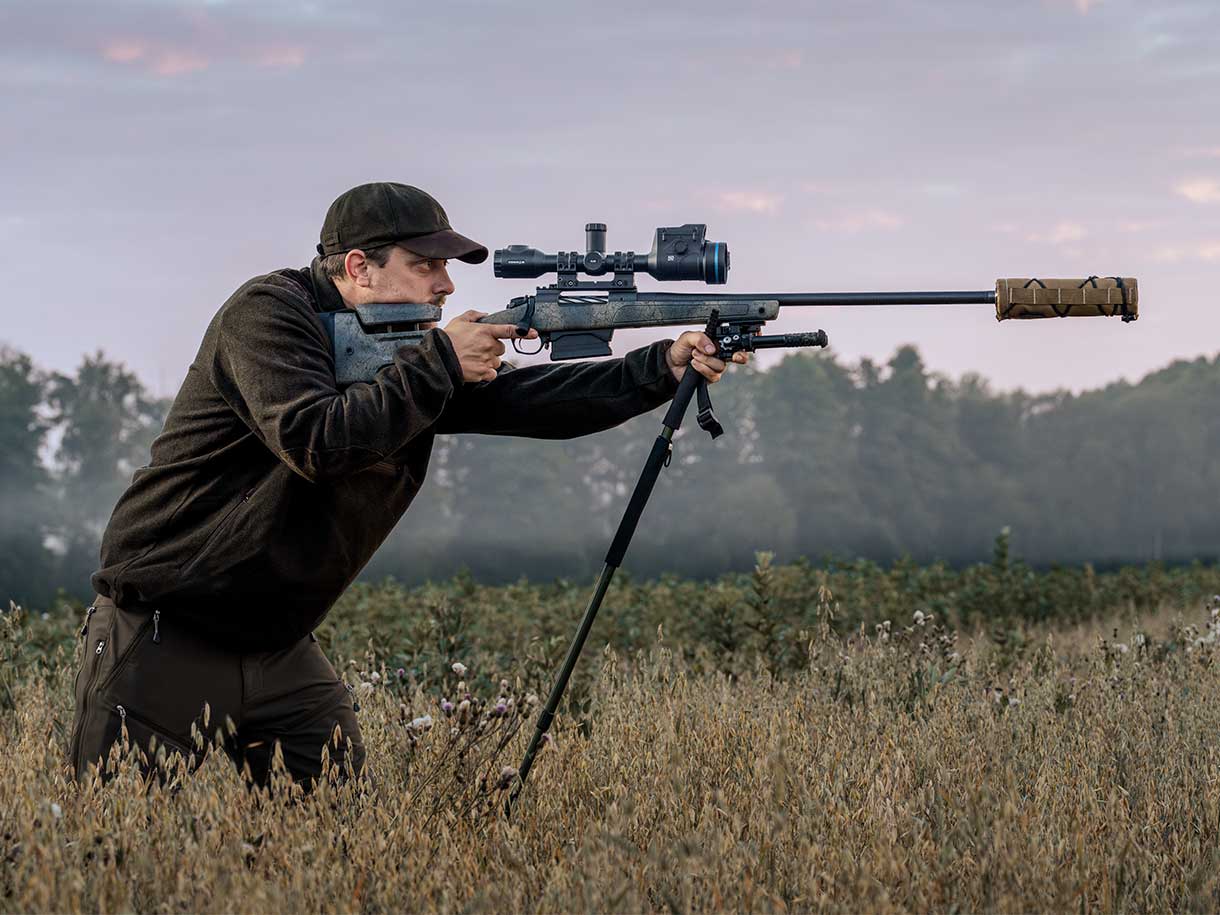
From his testing, latency in the range of 0.05–0.07 seconds allows him to maintain the same shooting accuracy he achieves with analog optics.
Higher latency can still be manageable if the hunter understands the limitations. In such cases, the shooter may reduce risk by:
- shooting from a prone position,
- using a tripod,
- shooting only at static animals,
- waiting for calm shooting situations.
What does detection range actually tell us
Many devices advertise impressive detection ranges, but this number can be misleading.
Detection range typically measures how far away a device can detect an object roughly 180 × 50 cm in size. However, detection does not mean identification.
Hunters often need to identify:
- the species,
- the gender,
- whether young animals are present.
From Orman’s experience, a practical rule is that about one-tenth of the advertised detection range is the maximum distance at which reliable gender identification becomes possible on wild boar.
In some situations it may be farther, but this usually requires a very experienced user who understands both the device and the behavior of the animal.
Why the field of view is critical for safe shooting
Because natural vision is limited at night, hunters rely entirely on what they can see through their optic.
A wide field of view helps the hunter understand the full situation around the target. It allows the shooter to see:
- what is happening beside the animal,
- what lies behind the target,
- whether a safe backstop is present,
- whether another animal could be hit due to bullet deflection.
For shooting distances closer than 50 meters, Orman recommends a field of view of at least 10 degrees.
As a reference, one degree of field of view equals roughly 0.8 meters in width at said distance.
How manufacturers can help hunters use optics more effectively
Finally, Orman emphasized the importance of better guidance from manufacturers.
Many hunters struggle to properly configure their devices. Clear instructions could help users understand how to adjust:
- gain and amplification,
- brightness and contrast,
- color palettes that reduce eye fatigue.
Providing better guidance would improve the overall user experience while also supporting responsible and ethical hunting practices.
From vision to decision
Modern hunting technology is evolving rapidly. While new features and AI capabilities offer powerful tools, they should never compromise the hunter’s ability to make the right decision in the field.
For Stefan Orman, the priority remains clear:
Latency should always come first.
Other features may be useful, but they should never become more important than delivering accurate and reliable information.
Only when the image is trustworthy can hunters confidently move from vision to decision.