
Can you truly trust your eyes when the forest goes silent? At dusk, under fog, or through tangled brush, even seasoned hunters miss what’s hiding in plain sight – unless they’re using thermal.
In this essential guide to thermal monoculars for hunting, we’ll explain how these handheld optics detect heat, why they outperform night vision in real terrain, and what features actually matter in the field. Whether you’re scouting, tracking, or ensuring safety, a thermal monocular offers unmatched awareness – if you choose the right one.
From sensor resolution to detection range, we’ll walk you through key buying criteria, real-world use cases, and expert-backed tips. This isn’t just about gear – it’s about ethical, effective, and conscious hunting.
Key Takeaways
- Detect game in the darkness or dense cover using thermal heat signatures, not visible light.
- Thermal monoculars outperform night vision for tracking, scouting, and safety.
- Look for resolution, sNETD, ergonomics, and laser rangefinders when choosing a model to ensure it meets your needs.
- Use compact models like the Axion XQ19 Compact for mobility, or the Telos LRF XL50 for long-range precision.
- Thermal helps track wounded animals, identify camouflaged predators, and avoid hazards – day or night.
Why Thermal Monoculars are Game-Changers for Hunters
For hunters, timing and visibility are everything. Thermal monoculars give you the ability to spot game without relying on light or movement, changing how and when you hunt. From early morning to post-sunset, they enhance your awareness, reduce guesswork, and improve results – all without revealing your presence.
To give you a practical insight, we asked Julia Nowak, a Polish huntress who discovered thermal vision years ago, how she integrates the devices in her hunts:
Thermal monoculars like the Axion XG35 Compact provide very comfortable and effective quick scanning of the terrain during stalking, thanks to their light weight and pocket size.
Related: Explore the Pulsar Axion Compact series in more detail.

What is a Thermal Monocular, and How Does It Work?
A thermal monocular is a handheld optic that detects heat, not visible light – turning infrared radiation into a visual image of temperature differences.
At its core, the device uses a microbolometer sensor – an uncooled thermal detector that reads heat emitted by animals, people, or terrain. The heat data is converted into an image, displayed in greyscale or color palettes that highlight contrast between warm and cool surfaces.
Julia’s Tip:
Adapting different color palettes on your Oryx LRF XG35 or Telos XP50 to weather conditions and terrain patterns will help you obtain the best possible image in every condition.
Unlike night vision, thermal monoculars don’t amplify light. They function equally well in total darkness, daylight, fog, smoke, and through partial obstructions like brush or tall grass. This makes them ideal for real-world hunting environments where visibility varies constantly.
Thermal monoculars are also passive systems – they emit no infrared beam and require no external illumination, preserving stealth.
Why are Thermal Monoculars Beneficial for Hunters?
Thermal monoculars enhance detection, tracking, and safety – making them one of the most versatile and valuable tools in a hunter’s kit.
Detect Game in Low Light or Total Darkness
Thermal imaging visualizes body heat, not light. That means game becomes visible even in pitch-black conditions – no moonlight or external illumination needed. For early morning hunts or nocturnal predator control, this gives hunters a massive advantage.
See Through Obstructions
Thermal monoculars can penetrate light fog, smoke, and dense brush by identifying temperature contrast. This allows hunters to spot animals that are well-camouflaged or motionless behind visual cover.

Track Wounded Game Ethically
Blood trails and body heat create thermal signatures that can be followed immediately after the shot. This supports ethical hunting practices by improving recovery rates and reducing lost game.
Julia’s tip:
You can use the Telos XP50 to quickly find a roebuck that jumped into very thick bushes after the shot.
Spot Hidden or Camouflaged Animals
Even in daylight, animals blending into natural terrain can be hard to detect. Thermal imaging makes them stand out, highlighting subtle movement or concealed positions.
Increase Situational Awareness and Safety
Thermal monoculars also improve hunter safety. They help identify other humans in the field – such as fellow hunters, hikers, or landowners – and reveal terrain hazards like cliffs or ditches in low visibility.
Tip: Keep a compact model like the Axion XQ19 Compact in your chest rig for fast, silent scans before moving through blind corners or thick woods.
Read more: the full review of the Pulsar Axion XQ19 Compact.
Speaking of moving – Julia emphasizes that thermal is irreplaceable in active hunts:
For hunters like me, who do not like to sit and wait for hours, but prefer to stalk and explore the terrain (which means walking long distances) it is super important to be able to quickly scan the area, but without carrying too much extra weight with me, as the basic hunting gear is way enough already. This is why I love the Axions. It will show you what you could easily miss with your own eyes or day optics, but it will not bring you neck pain and fit in your pocket at the same time!
By combining passive detection, broad terrain adaptability, and ethical tracking benefits, thermal monoculars give hunters both an edge and a responsibility. They don’t replace skill – they sharpen it.
Types of Thermal Vision Monoculars
Thermal monoculars vary widely in design and performance, but all share the same core function: detecting heat for improved visibility in low light and challenging terrain. Choosing the right type depends on your hunting style, terrain, and priority features.
Thermal Monoculars vs. Night Vision
Thermal monoculars detect heat, while night vision amplifies available light. Thermal excels in total darkness, fog, and dense foliage – offering consistent performance where night vision may fail.
Compact Thermal Monoculars
Designed for mobility, fast access, and one-handed use, compact thermal monoculars are ideal for active hunts, quick scans, or navigating dense terrain.
Examples:
- Axion XQ19 Compact
- Axion XQ30 Compact
- Axion XG30 Compact / XG35 Compact
Decision Shortcut: Choose compact models when weight, speed, and mobility are top priorities.

Performance-Class Monoculars
Balancing size and detection power, mid-size thermal monoculars offer broader utility for most hunting environments.
Examples:
- Oryx LRF XG35
- Telos XG50 / Telos LRF XG50
These are excellent for deer, hog, and predator hunters who want both field durability and reliable detail at longer distances.

Premium Long-Range Monoculars
Optimized for detection range, detail recognition, and feature-rich performance, premium thermal monoculars are built for challenging environments and high-demand users.
Examples:
- Telos LRF XL50
- Telos LRF XP50

Pulsar Tip: For large-property scouting or predator control over long distances, the Telos LRF XL50 delivers industry-leading recognition and detail.
Julia’s tip:
You can also utilize premium monoculars for proper wildlife management through selection of the right individuals. For example, you can very well see when a wild boar has long teats – even from a distance – so it means this is a leading mommy boar which shouldn’t be shot.
Explore further: the entire line-up of Pulsar thermal imaging monoculars.
Real-World Hunting Scenarios with Thermal Monoculars
Thermal monoculars prove their value when the conditions turn difficult. In these scenarios, their utility becomes clear: they save time, improve ethical outcomes, and increase field awareness.
Pre-Hunt Scouting and Observation
Thermal monoculars are invaluable tools for scouting travel routes, bedding areas, and game patterns – especially during early mornings or low-light evenings.
Use them to:
- Confirm animal movement before setting stands or blinds
- Detect heat signatures at long range from ridgelines or treelines
- Observe patterns without alerting game – no lights, no sound
When paired with trail cameras, thermal monoculars complete a full-spectrum scouting setup. They give you real-time data to supplement 24/7 motion-triggered imagery.
Of course, scouting will be different for every hunter, too. Here’s how Julia advises choosing a device for these situations:
Use a compact model like the Axion XG30 Compact if you are a true stalker and care about practical, light gear and prioritize quick detection and handiness above details.
Use Telos XL50 if your task is to focus on population management and individual selection, where every small detail matters to make the right decision.
Tracking Wounded Game
When daylight fades or terrain thickens, tracking blood trails becomes nearly impossible – unless you can follow residual heat.
Thermal monoculars allow hunters to:
- See body heat even after the animal has stopped moving
- Continue recovery efforts long past sunset
Julia also notes that thermal can be extremely helpful when things don’t go as planned:
Accidents can happen even to the best hunters. When an animal gets wounded, time is what matters to an ethical hunter. Using a thermal spotter shortens the time to spot the wounded game in higher grass or thick bushes, so that the hunter can quickly end the suffering.

Predator and Nuisance Animal Control
Predators like coyotes and invasive species such as feral hogs in the US or racoons in Europe are primarily nocturnal – and often elusive. Thermal monoculars give landowners and hunters the edge to manage them ethically and efficiently.
Benefits include:
- Fast detection across wide, open fields or wooded edges
- Improved identification and shot decisions at night
- Silent scanning without disrupting livestock or neighbors
Decision Shortcut: If your goal is to protect crops or livestock from night predators, a model with long-range detection and fast startup like the Telos XG50 offers critical response time.
Situational Awareness and Safety
In fog, darkness, or unfamiliar terrain, thermal monoculars enhance safety by revealing:
- Fellow hunters, vehicles, or property boundaries
- Obstacles like cliffs, water, or downed trees
- Directional heat cues to avoid getting turned around
In high-pressure areas or shared-use lands, this added awareness can prevent serious accidents.
Field Warning: Never assume you’re alone in the field. Thermal monoculars reduce guesswork and promote safer decisions, especially when it gets pitch dark.
Thermal Monoculars vs. Thermal Scopes vs. Thermal Binoculars: A Quick Comparison
Thermal monoculars, scopes, and binoculars serve different roles in the hunting toolkit – each optimized for a specific stage of the hunt. Choosing the right tool depends on your purpose: scanning, aiming, or extended observation.
Thermal Monoculars
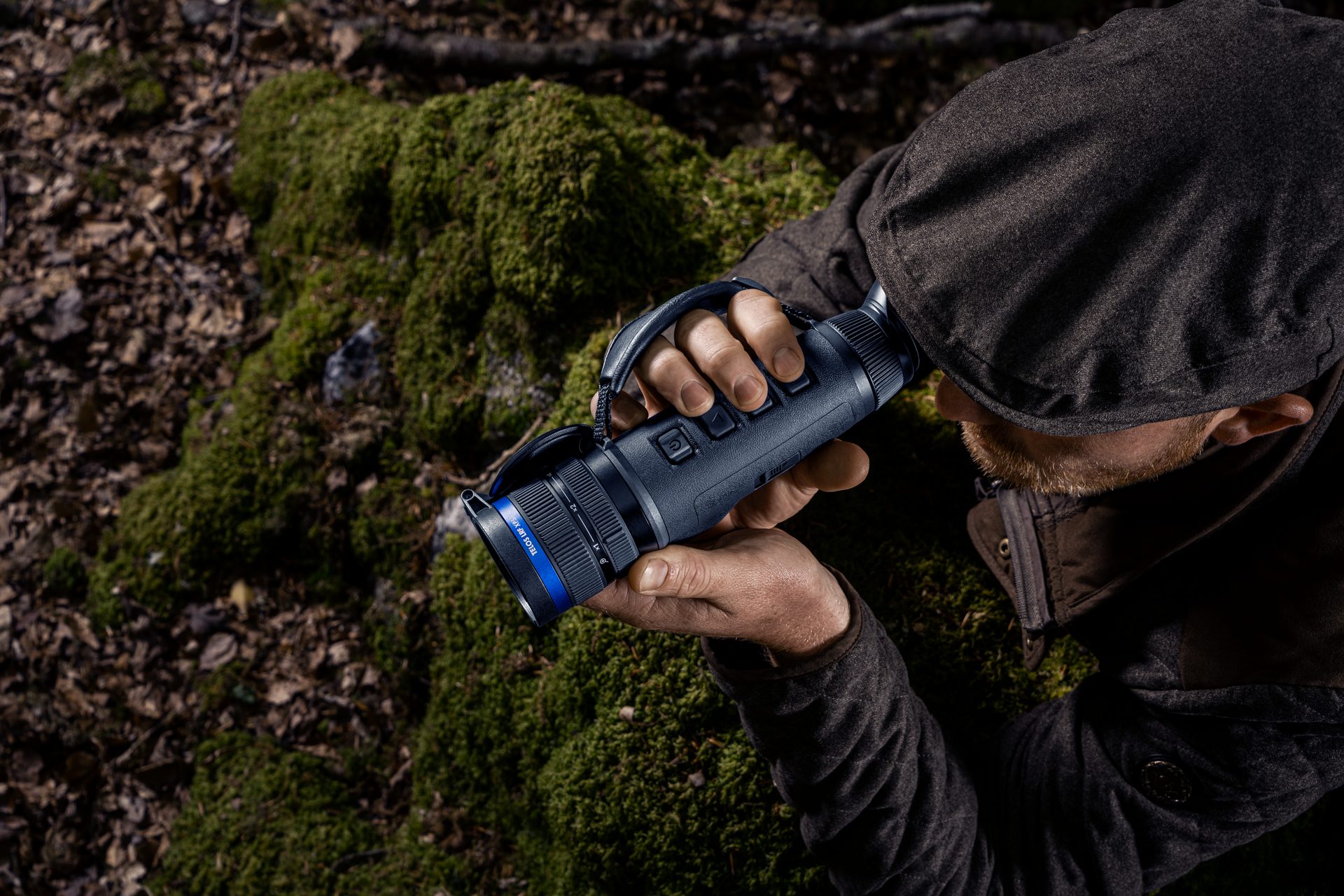
Designed for scanning and situational awareness, monoculars are compact, fast to deploy, and easy to use with one hand. They’re ideal for detecting heat signatures before engaging with a weapon-mounted optic or when navigating terrain.
Many models – such as the Axion XG35 Compact or Telos XP50 – offer high-resolution sensors and optional LRFs, making them suitable even for long-range recon.
Use when:
- Scouting pre- and during hunt
- Tracking wounded game
- Monitoring surroundings during movement or setup
- Needing a lightweight secondary device
Thermal Scopes
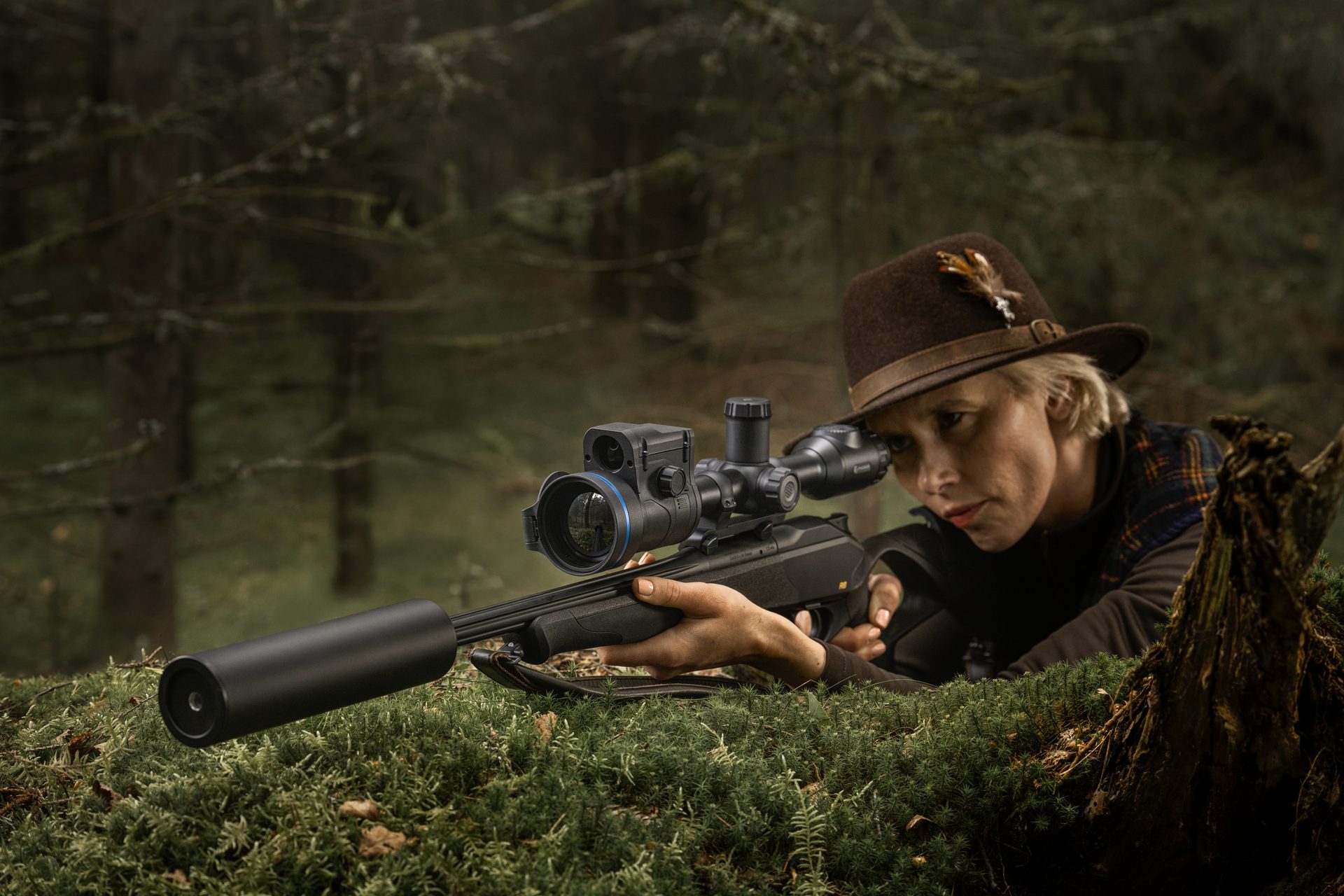
These are aiming devices mounted directly to your rifle, enabling safe shot placement in low visibility. Thermal scopes offer reticles, ballistic profiles, and advanced zeroing features, but are not optimized for general scanning or navigation. They work best when paired with a monocular for initial detection.
Use when:
- Engaging targets at known distances
- Hunting in full darkness
- Requiring precise thermal aiming solution
Read more: Best Thermal Rifle Scopes For Coyote Hunting
Thermal Binoculars
Thermal binoculars are two-eyed systems built for prolonged glassing, typically used in open landscapes or from fixed positions. They offer improved comfort for long observation but are heavier and less mobile than monoculars. Some premium monoculars, like the Telos LRF XL50, offer comparable clarity with more portability.
Use when:
- Observing large areas over long sessions
- Operating from high seats or hilltops
- Prioritizing comfort and detection range over mobility
By understanding the functional role of each tool, you can build a layered optic setup that supports scouting, targeting, and recovery – ethically and efficiently.
Dive deeper: Thermal Monocular vs Binoculars

What to Look for in a Thermal Monocular for Hunting
Choosing a thermal monocular for hunting involves more than just resolution or range – it’s about matching the optic to your terrain, game, and field use. The right features will improve clarity, comfort, and confidence when it matters most.
Sensor Resolution
Higher resolution means clearer images at longer distances. For example, a 640×480 sensor reveals more detail than a 384×288 – critical when identifying game through cover or in low contrast scenes.
- 384×288: Sufficient for short-to-mid-range scouting (e.g., Axion XQ19 Compact)
- 640×480: Better for dense terrain, animal ID, and detail (e.g., Telos XP50)
- 1024×768: Premium clarity for long-distance detection (e.g., Telos LRF XL50)
sNETD (Thermal Sensitivity)
sNETD stands for Noise Equivalent Temperature Difference, a key spec measuring how well the device can distinguish subtle temperature differences. Lower sNETD values (e.g., <25 mK) mean better sensitivity, especially in challenging conditions like cold mornings or rainy evenings.
Decision Shortcut: Prioritize low sNETD if you hunt in variable climates or target slow-moving game that blends into the background.
Read more: all you need to know about sNETD
Detection Range vs Recognition Distance
Detection range tells you how far a device can detect a heat source. Recognition distance is how far it can identify what that source is (animal vs human, deer vs wild boar).
- Example: Telos LRF XG50 may detect up to 2300 m but recognize game confidently at ~800–1000m
- Compact models like Axion XQ19 Compact are optimized for shorter-range scans (~1300m detection)
Understand these numbers in context: long detection is useless without clarity to identify the target.
Laser Rangefinder (LRF) Integration
Built-in LRFs provide instant distance measurements – essential for ethical and precise shot decisions and planning.
LRF-equipped monoculars are ideal for hunters operating in unfamiliar land or during predator management where distance decisions are critical.
Ergonomics and Portability
One-handed operation, button placement, and weight all matter in the field. Gloves, weather, or fatigue can affect usability.
- Axion series: Compact, pocketable, fast-booting
- Telos series: Modular, grippable, swappable battery design
Battery Life and Power Options
Field hunts can run longer than expected. Look for devices with swappable batteries (e.g., APS5/APS3 systems) or external power support.
- Cold-weather performance is also critical – ensure the battery holds up below freezing
- Consider quick-charging or hot-swap systems if operating away from power sources
When selecting a thermal monocular, match its capabilities to your most demanding hunting scenario. A few extra minutes spent evaluating specs can mean the difference between a missed opportunity and a successful, ethical shot.

How to Choose the Right Thermal Monocular for Your Hunting Needs
Choosing the right thermal monocular starts with where you hunt, what you hunt, and how you hunt. Specs alone aren’t enough – field context is what turns features into results.
Match to Your Terrain
- Dense forests or mountain terrain: Prioritize wide field of view and sensitivity.
- Open fields or large properties: Long-range detection and LRF integration become vital.
- Mixed terrain: Look for a balance of mobility, clarity, and range.
Read more: Best Thermal Monoculars For Hunting
Game Type and Behavior
- Deer or elk: Use 640×480 or higher resolution.
- Predators like coyotes or hogs: Choose models with fast boot time and LRF for responsive action.
- Small game: Requires tighter field of view and fine thermal detail.
Budget Considerations
Thermal monoculars range widely in cost, but price alone doesn’t determine field value. Consider:
- Entry-level performance: Axion XQ19 Compact
- Mid-tier performance: Oryx LRF XG35
- Premium class: Telos LRF XL50
Field Warning: Buying below your needs often results in frustration or premature upgrades. Prioritize clarity and range that suits your most demanding hunt.
Ergonomics and Field Usability
A monocular is only useful if it fits your hunting style:
- One-handed control for fast mobility
- Fast boot-up times for spontaneous use
- Intuitive controls that work with gloves or under stress
Pulsar Tip: The Telos series offers customizable ergonomics and grip rotation — ideal for left- or right-handed users and various carry styles.
Dive Deeper: How to Choose Thermal Imaging Monocular for Hunting
Maintenance and Care for Your Thermal Monocular
Proper maintenance extends the lifespan and performance of your thermal monocular – ensuring it’s ready when you are. While these optics are built for rugged use, simple care habits can prevent degradation and field failure.
Cleaning and Storage
- Lens Cleaning: Use a soft microfiber cloth and optics-safe cleaner. Avoid household glass cleaners – they may damage coatings.
- Sensor Protection: Always replace the lens cap when not in use.
- Post-Hunt Drying: If used in rain or humidity, allow the unit to air dry before sealing it in a case.
- Storage: Store in a dry, padded case with silica gel packs to prevent condensation buildup.
Battery Best Practices
- Charge Regularly: Recharge batteries after every outing.
- Avoid Full Drain: Lithium-ion cells last longer when not fully depleted.
- Cold Weather Care: Batteries lose performance in sub-zero temps. Keep spares in an inner pocket to preserve charge.
- Swappable Systems: If using APS3 or APS5 battery packs, carry one fully charged spare in the field.
Software Updates
All Pulsar monoculars receive regular updates via the Stream Vision 2 app. These can improve image processing, battery life, or interface functions.

Tips for Maximizing Thermal Monocular’s Performance in the Field
Even the most advanced thermal monoculars require proper setup and use to deliver peak performance. Field conditions vary – your monocular must adapt with you.
Proper Calibration and Settings Adjustments
- Calibration Modes: Most Pulsar monoculars offer automatic, semi-automatic, and manual calibration. Use semi-automatic for real-time control and avoiding the need to close the cap every time.
- Image Optimization: Adjust brightness, contrast, and sensitivity settings based on background temperature – warm rocks and cool air require different tuning.
- Color Palettes: Use “White Hot” for broad scanning, “Red Hot” for focused targets, and “Black Hot” for spotting faint signatures in high contrast terrain.
As Julia notes, these adjustments aren’t here just for the sake of it – they might actually improve your experience in the field a lot:
Do not stay just with the default settings. Test the different color palettes and image settings – they are there to help you obtain the best possible image in every situation.
These adjustments will also make the device more fitted to you – find a set that will feel comfortable for your eyes.
Battery Care and External Power Solutions
- Start Fully Charged: Always enter the field with full batteries.
- External Power Banks: USB-C external batteries extend runtime, especially in cold weather. Ensure they’re compatible and weather-rated.
Maintenance and Cleaning for Longevity
- Post-Hunt Wipe Down: Remove mud, dust, and moisture before storage. Avoid submerging the unit.
- Lens Check: Inspect regularly for scratches or smudges — they degrade thermal clarity fast.
- Firmware Audit: Once per season, check for app updates and feature enhancements.
Field Warning: Thermal image degradation often comes from dirty or scratched lenses – not the sensor. Protect them diligently.
Conclusion
Thermal monoculars are more than just high-tech optics – they’re essential tools for modern hunters who value awareness, precision, and ethical field practice. Whether you’re tracking in the dark, scanning dense brush, or recovering wounded game, thermal vision provides clarity where natural sight cannot.
By understanding how thermal monoculars work, what features to prioritize, and how to apply them in real-world hunting scenarios, you can choose the right tool with confidence. Compact models like the Axion XQ19 Compact offer unmatched mobility, while long-range options like the Telos LRF XL50 deliver precision over distance. Each has its place – the key is matching your optic to your needs.
Investing in thermal isn’t just about gear – it’s upgrading the way you hunt. The result? Cleaner recoveries, sharper decisions, and safer days in the field.
Explore Pulsar’s approved thermal monocular range to find the right match for your hunting goals.
Frequently Asked Questions
Is a thermal monocular good for hunting?
Yes. Thermal monoculars allow hunters to detect game in total darkness, dense brush, or fog by reading heat signatures — improving tracking, safety, and ethical recovery.
Can you use a thermal monocular in daylight?
Absolutely. Thermal monoculars function independently of light, making them effective both day and night. Bright sunlight or reflective surfaces may affect contrast, but heat detection remains reliable.
What resolution is best for a thermal monocular for hunting?
For general hunting, 384×288 offers good performance. If you need better detail for identifying animals at distance or in complex terrain, 640×480 or higher is ideal. The Telos LRF XL50 features 1024×768 resolution for maximum clarity.
How far can a thermal monocular see?
Detection ranges vary by model — from ~1300m for compact units like the Axion XQ19 Compact, to over 2300m for premium models like the Telos LRF XG50. Recognition distance (knowing what you’re seeing) is always shorter than detection range.
Are thermal monoculars legal for hunting?
It depends on your region. Some states or countries regulate thermal optics during certain seasons or for specific game. Always check local hunting laws before using thermal gear.
How long do thermal monocular batteries last?
Typical runtime is 4–8 hours, depending on the model and settings. Pulsar’s APS battery systems allow hot-swapping in the field for extended use.
What is NETD in thermal imaging?
NETD (Noise Equivalent Temperature Difference) measures how well a sensor detects subtle temperature variations. Lower NETD means better image clarity in low-contrast conditions — ideal for early mornings or rainy days.
Which thermal monocular is best?
It depends on your use case. For mobility and short-range scanning, the Axion XQ30 Compact excels. For long-range precision and feature depth, the Telos LRF XL50 is a top-tier choice.
About the Expert

Julia Nowak was born and raised in a hunting family in Poland and now lives — and continues to hunt — in Sweden. She holds a degree in sustainable forest and game management, bringing both tradition and scientific knowledge to her pursuits.
For Julia, hunting is not just a hobby; it’s a way of life. She also runs the YouTube channel Hunting O’Clock, where she shares her experiences and insights from the field.